


Local search drives over 70% of leads for real estate agents, yet many miss out by ignoring key updates in 2026. The rise of AI overviews and map pack dominance means your Google Business Profile and website need sharper focus than ever. This guide breaks down how to master real estate local SEO, from neighbourhood keywords to tracking your results, so you won’t lose ground in a crowded market.
Why Local SEO is Your Secret Weapon in 2026
Real estate is a hyper-local business. When someone searches “homes for sale near me” or “best realtor in [neighborhood],” they’re ready to act. Your visibility in those moments determines whether you win the listing or lose it to a competitor.
Here’s what’s shifted in 2026:
- AI Overviews dominate search results. Google now pulls answers directly from top-ranking local content, meaning your website needs to answer specific questions better than anyone else.
- Map pack rankings matter more than ever. The top three spots in Google Maps capture 90% of clicks. If you’re not there, you’re invisible.
- Mobile-first indexing is non-negotiable. Most property searches happen on phones, and slow sites get buried.
The agents who win in 2026 understand real estate local SEO isn’t optional. It’s the foundation of every successful marketing strategy.
Section 1: Google Business Profile Mastery
Your Google Business Profile is your digital storefront. It’s where potential clients form their first impression, read reviews, and decide whether to contact you.
Claiming and Completing Your Profile
Start here:
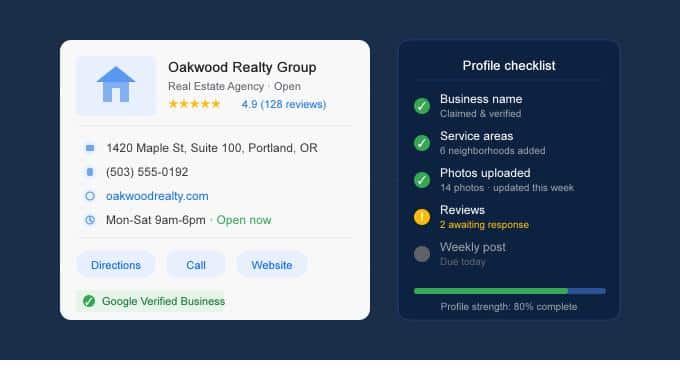
- Claim your profile at business.google.com
- Verify your business address (use your office, not a P.O. box)
- Fill out every single field. Incomplete profiles rank lower.
- Add your service areas if you cover multiple neighborhoods
Google rewards profiles that provide complete, accurate information. Leave nothing blank.
Choosing the Right Categories
Your primary category should be “Real Estate Agency” or “Real Estate Agent.” Then add secondary categories:
- Property Management Company
- Real Estate Consultant
- Commercial Real Estate Agency (if applicable)
Categories signal to Google what searches you should appear in. Choose wisely.
Posting Updates, Photos, and Q&As
Active profiles rank higher. Here’s your weekly routine:
- Monday: Post a new listing with high-quality photos
- Wednesday: Share a market update or neighborhood highlight
- Friday: Add client testimonials or success stories
Upload fresh photos every week. Show:
- Exterior and interior shots of listings
- Team photos
- Community events you’ve attended
- Before/after staging transformations
Monitor and answer questions in the Q&A section. Competitors can post questions, so stay vigilant and provide helpful, keyword-rich answers.
Getting and Responding to Reviews
Reviews are ranking signals and trust builders. Here’s how to get more:
- Ask every client after closing
- Send follow-up emails with direct review links
- Make it easy (one-click process)
- Respond to every review within 24 hours
When responding:
- Thank positive reviewers by name
- Address concerns in negative reviews professionally
- Include neighborhood keywords naturally (“We’re glad you loved your new home in Oak Park!”)
Your Google Business Profile is the cornerstone of local SEO. Treat it like your most valuable marketing asset.
Section 2: On-Page Local SEO for Agent Websites
Your website needs to speak the language of local search. That means targeting the exact phrases potential clients type into Google.
Targeting Neighbourhood-Level Keywords
Broad keywords like “real estate agent” won’t cut it. You need hyper-local terms:
- “3-bed homes in Riverside”
- “condos for sale in downtown Portland”
- “family homes near Lincoln Elementary”
- “luxury properties in Westlake”
Research neighbourhood keywords using:
- Google’s autocomplete suggestions
- “People also ask” boxes
- Local forums and community groups
- Your own client conversations
Build a spreadsheet of 20-30 neighborhood-specific phrases. These become the foundation of your real estate website optimization strategy.
Creating Individual Location Landing Pages
Generic “Areas We Serve” pages don’t rank. You need dedicated pages for each neighborhood:
Page structure:
- H1: “Homes for Sale in [Neighborhood]”
- Introduction with local context
- Current listings (if available)
- Neighborhood statistics (median price, school ratings, walkability)
- Local amenities (parks, restaurants, shopping)
- Transportation and commute times
- FAQ section
- Call-to-action (schedule a showing, get a free valuation)
Each page should be 1,000+ words and genuinely useful. Include:
- Embedded Google Maps
- Photos of the neighborhood
- Links to local schools and businesses
- Market trend data
This is real estate content strategy that actually converts. You’re not just chasing rankings; you’re becoming the go-to resource for that area.
Schema Markup for Real Estate Listings
Schema markup tells search engines exactly what your content represents. For real estate, use:
- LocalBusiness schema for your agency
- RealEstateAgent schema for individual agents
- Product schema for individual listings
- FAQPage schema for Q&A content
Proper schema helps you appear in rich results and AI Overviews. If you’re not technical, work with a developer who understands structured data.
Your website isn’t just a brochure. It’s a ranking machine when optimized correctly.
Section 3: Building Local Authority
Authority comes from how the broader web talks about you. Citations, backlinks, and consistent information all signal trustworthiness to Google.
Getting Property Portal Citations
List your business on every relevant platform:
- US agents: Zillow, Realtor.com, Trulia, Redfin
- UK agents: Rightmove, Zoopla, OnTheMarket
- Australian agents: Domain, realestate.com.au
Property portal citations serve two purposes:
- Direct lead generation
- Authoritative backlinks that boost local rankings
Complete your profiles fully. Add photos, descriptions, and links back to your website. Consistency matters.
Local Backlinks from Community Sites and Press
The best backlinks come from local sources:
- Sponsor a little league team (get a link from their site)
- Write guest posts for local blogs
- Get featured in community newspapers
- Partner with local businesses (mortgage brokers, home inspectors)
- Participate in chamber of commerce events
Quality beats quantity. One link from your city’s official website is worth more than 100 links from random directories.
Pitch yourself as a market expert:
- “Our agent can provide Q1 housing data for your article”
- “We’d love to sponsor your charity event”
- “Can we write a homebuyer guide for your audience?”
Local press loves local experts. Position yourself as the authority.
NAP Consistency Across the Web
NAP stands for Name, Address, Phone number. Google cross-references this information across hundreds of sites.
Your NAP must be identical everywhere:
- Website footer
- Google Business Profile
- Facebook page
- Property portals
- Directory listings
- Email signatures
Even small variations confuse search engines:
- ❌ “123 Main St.” vs. “123 Main Street”
- ❌ “(555) 123-4567” vs. “555.123.4567”
- ❌ “Smith Realty” vs. “Smith Realty LLC”
Pick one format and stick to it. NAP consistency is a foundational element of local SEO that many agents overlook.
Section 4: Content That Ranks Locally
Content isn’t just blog posts. It’s your ticket to dominating local search results.
Neighbourhood Guides as SEO Assets
Create the definitive guide for each area you serve:
- “The Complete Guide to Living in [Neighborhood]”
- “Moving to [City]? Here’s What You Need to Know”
- “[Neighborhood] Real Estate Market Report 2026”
Include:
- History and character of the area
- Demographics and lifestyle
- Schools and education
- Parks and recreation
- Dining and entertainment
- Transportation options
- Housing market trends
- Pros and cons of living there
These guides become evergreen assets that rank for years. Update them quarterly to keep them fresh.
Market Update Blog Posts (Monthly Cadence)
Publish monthly market updates:
- “March 2026 Real Estate Market Update: [City]”
- “What’s Happening in [Neighborhood] Real Estate This Month”
- “Spring Market Trends in [Area]”
Include:
- Median sale prices
- Days on market
- Inventory levels
- Buyer vs. seller market analysis
- Predictions for next month
This real estate content strategy positions you as the expert who has their finger on the pulse. Clients trust agents who understand market dynamics.
FAQ Pages Targeting “Near Me” Queries
Create FAQ pages that answer common questions:
- “How much are homes in [neighborhood]?”
- “What’s the best school district in [city]?”
- “Should I buy or rent in [area]?”
- “How long does it take to sell a house in [neighborhood]?”
Structure each answer with:
- Clear, direct response in the first paragraph
- Supporting details and data
- Call-to-action (contact us for personalized advice)
FAQ content captures “near me” searches and voice queries. When someone asks their phone a question, your FAQ page can be the answer.
Section 5: Tracking Local SEO Performance
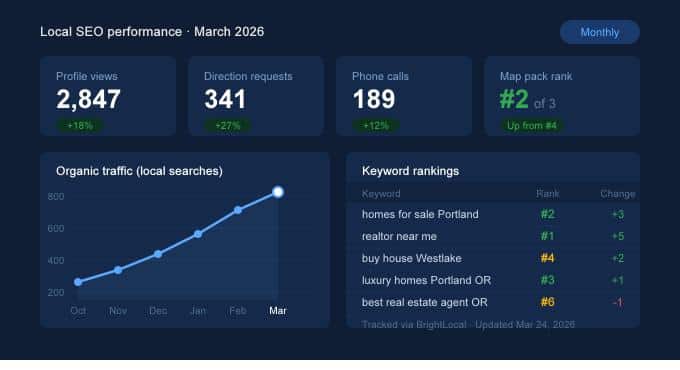
You can’t improve what you don’t measure. Tracking local SEO performance tells you what’s working and where to double down.
Essential Tools
Google Search Console (Free)
- Shows which keywords drive traffic
- Identifies technical issues
- Tracks your search visibility over time
BrightLocal (Paid)
- Monitors local rankings across neighborhoods
- Tracks citations and NAP consistency
- Provides competitor analysis
Semrush (Paid)
- Keyword research and tracking
- Backlink monitoring
- Site audit tools
Start with Google Search Console. Add paid tools as your budget allows.
KPIs to Watch
Track these metrics monthly:
Google Business Profile:
- Profile views
- Search queries (what terms people used to find you)
- Direction requests (high-intent signal)
- Phone calls
- Website clicks
Map Pack Rankings:
- Where you rank for target keywords
- Visibility in target neighborhoods
- Competitor movements
Website Metrics:
- Organic traffic from local searches
- Bounce rate on location pages
- Form submissions and calls
- Time on page for neighborhood guides
Citation Health:
- Number of citations
- NAP accuracy score
- New citations added
Set up a simple dashboard or spreadsheet. Review it the first Monday of every month. Look for:
- Which neighborhoods drive the most traffic?
- Which content pieces get the most engagement?
- Where are you losing ground to competitors?
Adjust your strategy based on data, not guesswork.
Quick Wins to Start Today
You don’t need to overhaul everything at once. Start with these high-impact actions:
Week 1:
- Claim and complete your Google Business Profile
- Upload 10 high-quality photos
- Ask your last three clients for reviews
Week 2:
- Audit your NAP across all platforms
- Fix any inconsistencies
- Create citations on top property portals
Week 3:
- Build one neighborhood landing page
- Target your most lucrative area
- Include all elements from Section 2
Week 4:
- Publish your first market update blog post
- Set up Google Search Console
- Create a tracking spreadsheet
These quick wins build momentum. You’ll see results within 30-60 days.
Partner with Experts Who Get Real Estate
Real estate local SEO isn’t a one-time project. It’s an ongoing strategy that requires expertise, consistency, and adaptation to algorithm changes.
At DesigningIT, we specialize in real estate website optimization and comprehensive local SEO strategies. We’ve helped agents across the country dominate their local markets through:
- Custom-built, mobile-first websites
- Google Business Profile management
- Content strategies that rank
- Citation building and backlink campaigns
- Monthly performance tracking and reporting
You focus on closing deals. We’ll handle the digital strategy that fills your pipeline.
Ready to own your local market? Visit our real estate web services page to learn how we can build a local SEO strategy tailored to your market.
The agents who invest in local SEO today will dominate tomorrow. Don’t wait until your competitors have taken all the top spots.
Your next client is searching right now. Make sure they find you first.